
Dad and me
One year on...

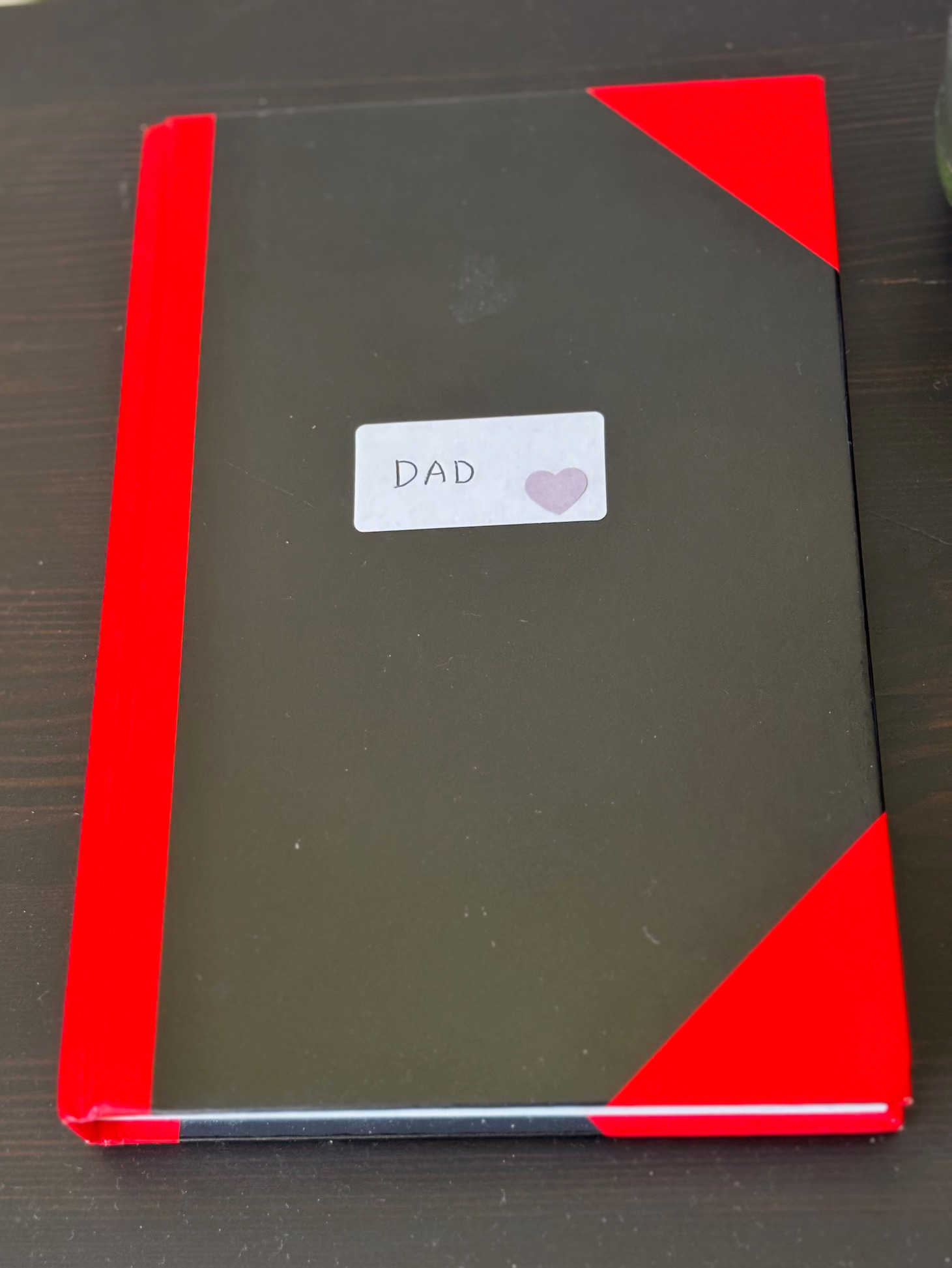
Last month completed a cycle for me — a year of writing daily letters to my dad. He passed away 26 November 2024 but I only found out on the 27th. I was by myself at the time. Feeling lost, shocked and frozen, I did what I do best, I took pen and paper and wrote what would be my first letter to him. Writing is my prime form of flow, something moves in me and through me.
That, now slightly tattered, piece of paper remains with me in my wallet. But it inspired 12 months of other similar letters, all enclosed in a small book simply titled Dad.
This process has been cathartic, healing, confronting, comforting and revealing. It has helped me transition through his death and all that comes with it. What started with me at a loss has turned into something I never anticipated at the time. The way the letters have morphed over the year track my own journey of mourning. Not linear but more cyclical through the full spectrum of seasons — winter, spring, summer and autumn.
It also has given me an interesting insight about AI. It’s reminded me of why it will never replace true creativity. Because human writing or art of any kind is a process. Of enquiry, of curiosity, of revelation, of deep diving, born of lived pain and joy. I’m not talking about sales writing but the kind of writing that turns one’s insides out, all feelings welcomed.
I’m not sure why people need to stamp their pieces with ‘not written by AI’ or ‘written by a human’. I recognise the difference. Do you?
I try to imagine a book written by AI. Where does it get the plot from. Who creates the thread. Who dreams up the characters. Who offers their life up on a platter for consumption.
Can AI sit in the sunshine and describe the feeling of the warmth kissing your cheek or the breeze brushing up against your skin and twirling your hair. Can it jump into my belly and pinpoint the sharp ache that has taken up a permanent space in my being since Dad passed.
Death is a very human experience. It’s a blood, bones and flesh thing. It’s visceral. The loss of a beating heart is unique to those who are mortal. Only those who have one can recognise a missing one.
I’ve used AI for coaching advice during a couple of courses I’ve been part of. It’s been useful and informative, but I know the difference between it and a therapist. It collates information not unlike I used to do when writing essays at school or university. I didn’t have experience of the subject, I wasn’t living in that phase of history, I didn’t live on that side of the world or inside the head of the scientist or historian, but I could gather all that and drop it on to a piece of paper, or many pieces of paper.
The outpouring into Dad’s book inspired this conversation about AI as it re-inspired my desire to write books. It also re-inspired me to get back to this Substack which I haven’t been writing for some time. I keep hearing that AI is going to replace creative jobs, but even if it is a greater form of collective consciousness (and I’m not convinced of this personally) it is definitely not human. And humans will always need humans. We will always desire a sensory connection with the elements, with earth, with time and space. We will always tell stories and want to read stories — human stories.
My relationship with Dad is such a story. The questions I struggled with are a human story. The feelings that moved through me are part of a human story.
The process of writing this book left me with a profound understanding of our human stories. What I’ve learnt through the process is that there is always an ‘after,’ even if it’s not the same as what we’ve known in the ‘before’. I never thought I’d talk to Dad again after he passed, but I have. And I now know I always will. It’s simply a different season.
365 days after I started it, I closed Dad’s book with shaky yet sturdy hands. I committed to it for one year, but like any cycle — and any book — I felt it needed a beginning and an end. I’ll miss those daily scribbles, but I also trust that something else will arise, actually it already is as this book is starting to form the skeleton of another.
Thanks for writing this, it clarifies a lot. What if an AI, despite all our advancements, could truely grasp the lived, non-linear experience of such a profound journey?