
Honouring their names
Bringing light into darkness

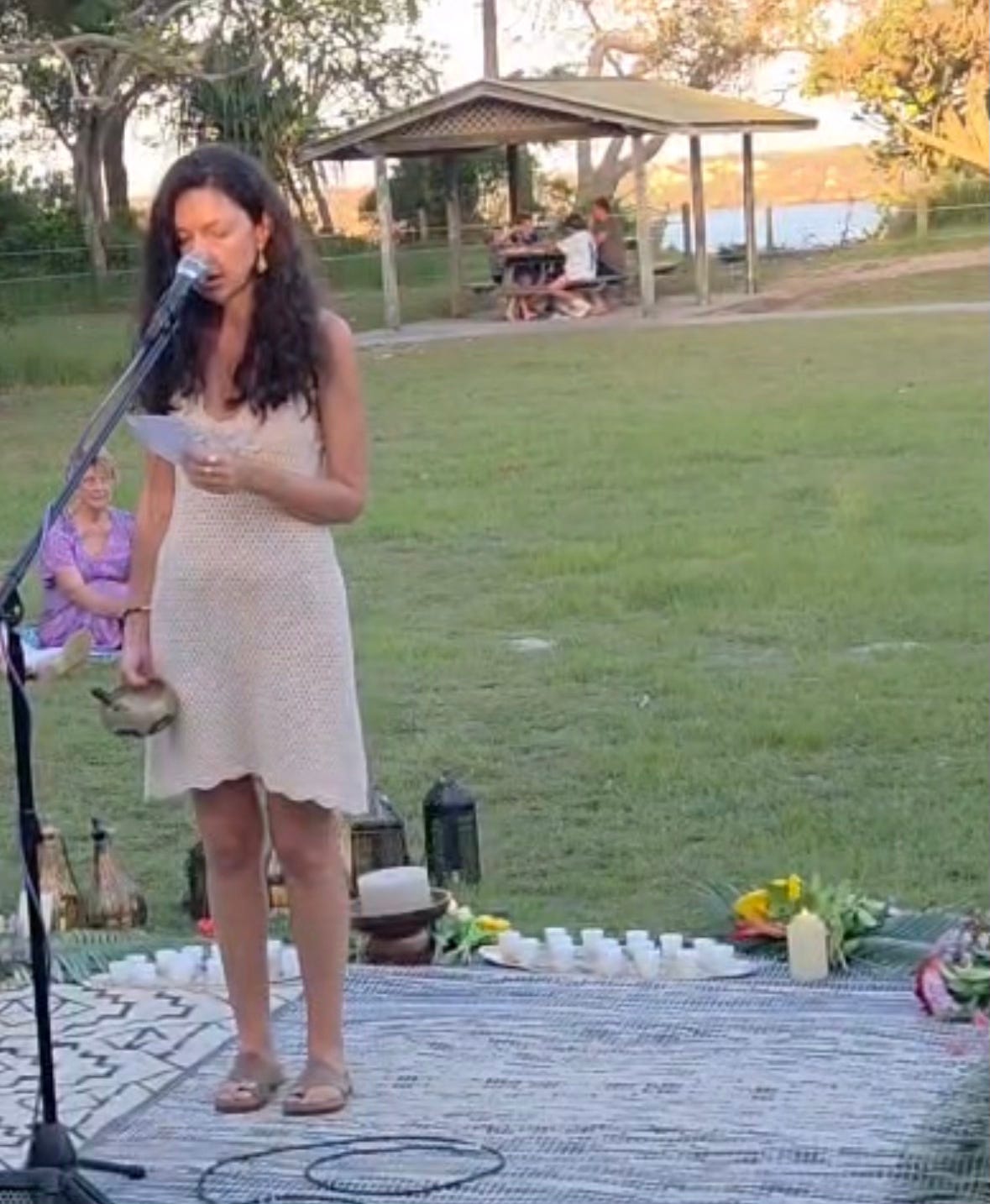
On Thursday evening, just as the sun set over a clear, warm January day, my local community held a vigil to mark the National Day of Mourning for the Bondi terrorist massacre.
I was honoured with the gift of reading out the names of the 15 people killed that fateful December summer’s evening. The 15 light-filled individuals who had gone to a festive Chanukah celebration only for it to be invaded with evil, an evil that would end their lives.
In Jewish tradition, the reciting of the names of the deceased honours their memory and also keeps them present in the lives of the living. An embodied way of calling these blessed departed souls in.
Around the same time as our small vigil, a larger memorial was being held at the Sydney Opera House. For Jewish Australians it was a full circle moment from the horrific protest held on 8 October 2023 on the steps of the Opera House. The protest where Australian flags were burnt, where the atrocities of the October 7 terrorist attack in Israel were being celebrated. A protest held while bodies were still being recovered. Often bodies that were no longer bodies, but body parts and in some cases, single teeth or burnt bones. The protest where there was a call for Jews. Whether the words used were ‘Fuck the Jews’, ‘Gas the Jews’, or ‘Where are the Jews’ is irrelevant. It was still a call, and not an inviting one.
At the memorial, we were able to bring light back to Australia’s icon and show who we are — who we are in death and who we are in life. A night of commemorating the deceased, remembering their lives, acknowledging the heroic efforts of the numerous Australians who risked their own lives that day and a call for a safer and more harmonious country.
Yet, the two snipers perched on the roof of the Opera House told the story none of us really wish to hear. That Australia changed irrevocably on 14 December 2025. And that it had already been changing in the two years prior, beginning with the leniency given to that 8 October 2023 protest.
Earlier in the day, before I arrived at my vigil, I’d been shaken by various comments I’d encountered on social media posts talking about the National Mourning Day. At best these comments condemned the day, at worst they were vicious, vile and filled with ‘whataboutism’, the latest modern global disease.
Many said they didn’t want to be converted to Judaism, inferring dislike of the suggestion to do a mitzvah on this day. They didn’t want religion to infiltrate the Australian way.
That made me sad because that’s not at all what the day was about. It was a day of reflection, of remembrance of lives lost and of humanity and what we can do to bring forth a more united Australia. A mitzvah is essentially a good deed, nothing more, nothing less. The concept crosses all religions, faiths and races.
What most don’t understand is that you don’t have to be religious to follow Jewish customs. Like you don’t have to be Hindu to chant in Sanskrit or be a Buddhist to meditate.
Actually many Jewish people consider themselves secular, and we can be because we’re an ethno-religion. So much of what we do is custom, tradition and ritual based, tracing back millennia and pre-dating religion.
I wish to share with you something that happened at these events — my small local one and the national one — that truly exemplifies Jewish spirit. At both events two songs were sung, one titled Loh Le’Fached which translates to ‘having no fear at all’ and the other, Oseh Shalom, which is the Jewish prayer for peace. As the singers transitioned from one song to the other, audiences in both locations broke into dance. At my local event, beachgoers who passed by joined in, and at the Opera House the likes of John Howard joined in. The beauty of our culture is the way we weave between death and life, solemness and celebration, stillness and dance, grief and joy. It’s what keeps us going, we rise and fall, over and over again.
Moving from darkness to light is familiar to us. It’s etched in our history and our genes. So much so that we follow a lunar-solar Judaic/Hebrew calendar. We are unique in this combination. The year is ruled by the sun, but the months are ruled by the moon. The sun representing the consistent light, the faith in a higher consciousness that is always present. And the moon representing the cyclical nature of life, the flux, the rising and falling, the emptiness and fullness, the constant shifting tides of being a human.
I’m realising more and more that my role as a Jewish woman isn’t to be an advocate for a cause, but to be an advocate for who I am and who we are. This intersects nicely with who I wish to be as a woman — which is to be seen in my fullness.
Just like we reclaimed the Opera House last Thursday, these last few years I’ve reclaimed that part of me. I used to keep it in the shadow. That was easier. It was easier to not put it in the spotlight at the risk of being different, rejected, damned. But it made me smaller, more contained, less me.
It wasn’t lost on me that the names of the majority of the 15 I called came from the same place as my own paternal grandmother. They were Russian. So was she. As I practiced pronouncing their surnames, I thought of my own surname — Sztar. How often it would be misread. At school and at appointments everyone would stutter over it. I’d blush and cower; it was embarrassing as a young child to have a name no one could pronounce. A blend of Russian, German and Polish heritage, it is confusing. In Australia the ‘z’ is silent, but the ‘Sz’ can also be pronounced as a ‘Shtar’. It was my darling dad who taught me these nuances. As I wrote out the names to ensure I got each one correct, I wished my father had been around to help me. But I also knew that he’d taught me enough to work it out myself. In saying those names that night, I wasn’t only honouring those 15 departed souls, I felt as if I was also honouring the souls of my entire lineage. My father included.
Beautiful, Sharon 🙏